The agentic growth loop: how AI runs your marketing
Discover, create, test, launch — on repeat, mostly on its own. A field guide to the loop that turns a small team into a growth machine.
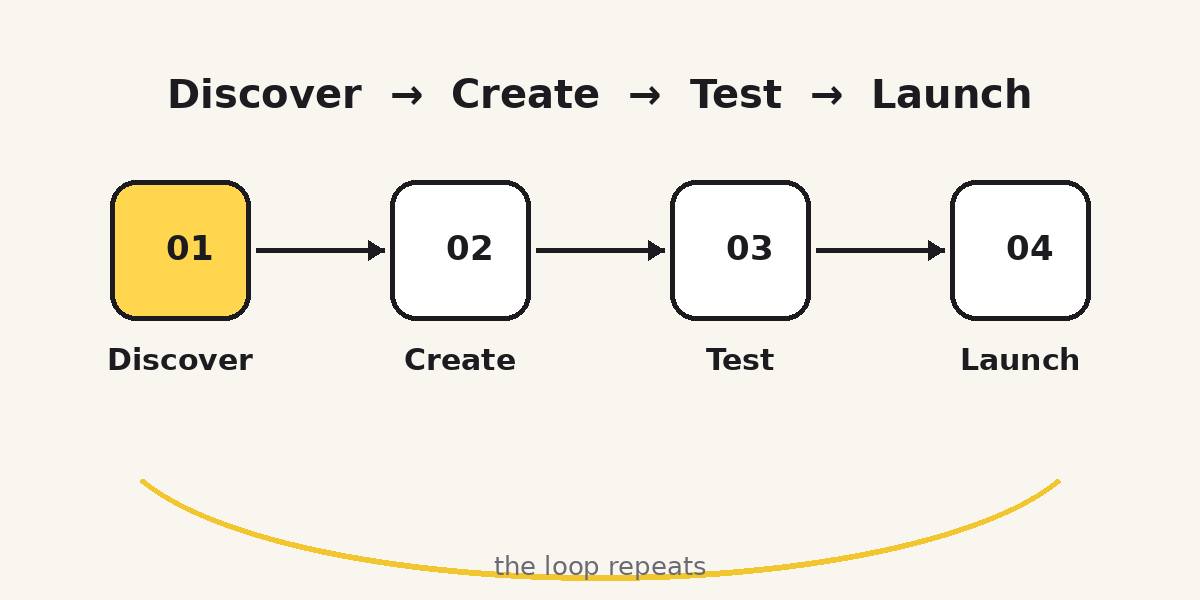
If traditional marketing was a set of hand-offs — strategist to writer to designer to media buyer — the agentic growth loop is one continuous engine. It discovers, creates, tests and launches on repeat, and it only stops to ask you the questions that actually need a human.
Why a loop, not a funnel
A funnel runs once, top to bottom. A loop compounds. Every campaign the engine ships teaches it something — which trend converted, which hook landed, which audience over-performed — and that lesson sharpens the next cycle. The team that loops fastest wins.
The four stages
Every agentic growth program comes down to four moves the engine makes for you:
- Discover — find the trend and the audience while the window is still open.
- Create — generate on-brand work at a volume a human team cannot match.
- Test — simulate performance and pick the winner before you spend.
- Launch — ship to every channel and optimise budget automatically.
Discovery is the unfair advantage
Most teams react to a trend after it peaks. An engine that reads every platform continuously can hand you the rising trend first:
- Watch the platforms where your buyers actually are.
- Score signals by momentum, not just volume.
- Surface the audience most likely to convert.
- Size it.
- Map it to a channel.
A trend you can act on this week is worth ten you read about next month.
Where each stage pays off
| Stage | Agent does | You decide |
|---|---|---|
| Discover | Surfaces rising trends + audiences | Which bet to chase |
| Create | Generates on-brand concepts | What is on-brand enough to ship |
| Test | Simulates + forecasts | Risk you are willing to take |
| Launch | Ships + reallocates budget | Guardrails and spend caps |
The engine drafts. You decide. That line is the whole philosophy.
Instrument it
Treat the loop like any growth system: measure, act, prove. On plans with API access, a minimal pull looks like this (example values):
# request
GET /v1/loop/metrics?brand=yourbrand&window=7d

# response
{
  "concepts_shipped": 128,
  "sim_accuracy": 0.92,
  "roas": 3.4,
  "trend_lead_days": 14
}
Wire roas and trend_lead_days into your dashboard and watch them move as the engine learns.
Where to start
Pick one channel and one audience. Let the engine run a full loop — discover, create, test, launch — and compare it to your last manual campaign. Then read our playbook on brand voice so everything it ships sounds like you.